
News
Featured News
- Claims & Litigation
- Legislative & Regulatory
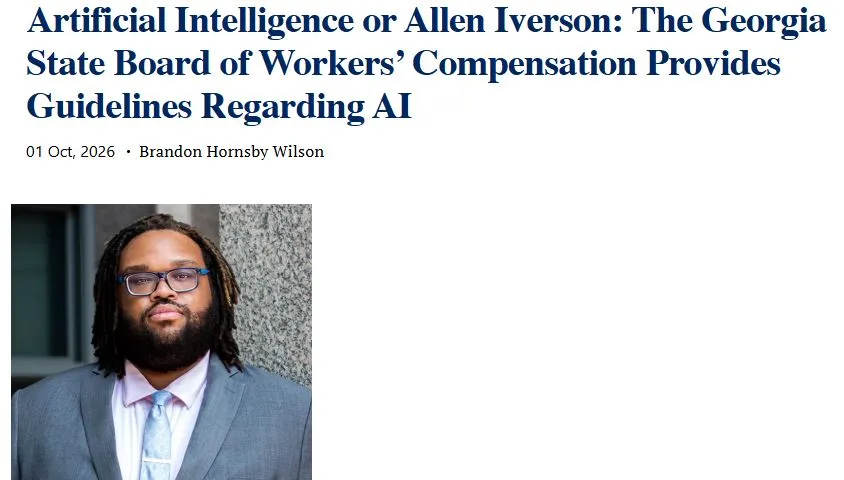
Georgia's State Board of Workers’ Compensation has established requirements governing the use of generative AI in briefs, motions and other written submissions. Attorneys and unrepresented parties using AI for drafting, editing, reviewing or checking filings must disclose that use and certify that they independently reviewed the document and verified…

- Legislative & Regulatory
Idaho announced two leadership appointments affecting the state's workers' compensation regulatory agency.
On October 8, the Commission announced the promotion of Patti Vaughn to Commission Director.
Vaughn has more than two decades of workers' compensation experience, including work involving medical fee schedules, benefits administration, and the transition to digital claims processes.
On October 9, the Commission announced the appointment of George Gutierrez as Employer Commissioner.
Gutierrez previously served as Commission Director and brings experience in workers' compensation, business ownership, and public administration.
On October 8, the Commission announced the promotion of Patti Vaughn to Commission Director.
Vaughn has more than two decades of workers' compensation experience, including work involving medical fee schedules, benefits administration, and the transition to digital claims processes.
On October 9, the Commission announced the appointment of George Gutierrez as Employer Commissioner.
Gutierrez previously served as Commission Director and brings experience in workers' compensation, business ownership, and public administration.

- Employer Compliance
- Workplace Safety / OSHA
OSHA cited a Pennsylvania excavation contractor following a fatal trench collapse involving a worker installing a storm sewer system approximately 12 feet below ground.
Investigators found that the trench lacked adequate protection against soil collapse.
The employer received a willful violation, two repeat violations, and three serious violations involving excavation safety, inspections, employee training, and related hazards.
OSHA proposed $254,884 in penalties. The employer may contest the findings.
Investigators found that the trench lacked adequate protection against soil collapse.
The employer received a willful violation, two repeat violations, and three serious violations involving excavation safety, inspections, employee training, and related hazards.
OSHA proposed $254,884 in penalties. The employer may contest the findings.

- Claims & Litigation
- Legislative & Regulatory
- Self Insurance
- Administration
Maine's Workers' Compensation Board is considering proposed amendments covering several important areas of workers' compensation administration.
The proposals address payment or denial of benefits, partial incapacity compensation, form filing, independent medical examinations, payment procedures, mediation, formal hearings, appeals, penalties, expenses, and electronic data interchange (EDI).
The Board held a public hearing October 9, and written comments remain open through October 19. The amendments are proposals, not adopted rules.
The proposals address payment or denial of benefits, partial incapacity compensation, form filing, independent medical examinations, payment procedures, mediation, formal hearings, appeals, penalties, expenses, and electronic data interchange (EDI).
The Board held a public hearing October 9, and written comments remain open through October 19. The amendments are proposals, not adopted rules.

- Employer Education
Texas DWC announced a free continuing-education webinar focused on return to work. The program will address early return-to-work practices, reducing lost time and employer costs, employee retention and the responsibilities of different workers’ compensation system participants.
- Claims & Litigation
- Employer Compliance
The owner of a Massachusetts temporary staffing company was sentenced to 13 months in prison after prosecutors said he concealed more than $6.2 million in payroll by paying temporary employees primarily in cash. Authorities said the false payroll figures were also used to obtain workers’ compensation coverage at artificially low premiums. He was ordered to pay more than $1.65 million in restitution.
- Carrier
Wisconsin workers’ compensation rates decreased by approximately 2%, marking the state's 11th consecutive annual decline. State officials estimate the reduction will save employers about $36 million on policies over the coming year. Actual employer premiums will still vary based on classification, injury exposure and individual experience.
- Legislative & Regulatory
- Research / Industry Trends
- Self Insurance
NCCI's new 2026 Legislative and Regulatory Trends Report identifies worker classification, portable benefits, mental injury, workplace safety and artificial intelligence among the issues shaping workers’ compensation policy this year. NCCI reports increased legislative attention to portable benefits for independent contractors and app-based workers.
The state activity is geographically broad. Louisiana, Oklahoma and Virginia enacted worker-classification legislation, while Alaska, California, Colorado and New Jersey considered related measures. Idaho, Vermont, Washington and West Virginia considered expansions of mental-injury or PTSD coverage, while Maryland, Minnesota and New York considered changes involving which medical professionals may diagnose qualifying conditions.
The state activity is geographically broad. Louisiana, Oklahoma and Virginia enacted worker-classification legislation, while Alaska, California, Colorado and New Jersey considered related measures. Idaho, Vermont, Washington and West Virginia considered expansions of mental-injury or PTSD coverage, while Maryland, Minnesota and New York considered changes involving which medical professionals may diagnose qualifying conditions.

- Legislative & Regulatory
- Medical
Several states are taking markedly different approaches to workers’ compensation pharmacy costs. Maryland is moving toward its first workers’ compensation pharmacy fee schedule using an acquisition-cost methodology. Mississippi's corrected fee schedule reinstated a $30-per-30-day cap on manufactured topical medications effective September 1. Texas has approved an audit plan targeting topical analgesics, while Arizona is considering a reimbursement threshold for prescription topicals.
- Claims & Litigation
- Legislative & Regulatory
- Self Insurance
Arizona has officially modernized its Notice of Claim Status (Form 104) and Recommended Average Monthly Wage (Form 108). Form 108 is now divided into a standard form for routine wage calculations and a supplemental version for more complex earnings situations. The new system also incorporates the notice of first payment into Form 108.
The change is directly aimed at insurance carriers, self-insured employers, TPAs and adjusters. Arizona is providing a 90-day onboarding period through December 21; after that, the modernized forms become mandatory and legacy versions will no longer be accepted.
The change is directly aimed at insurance carriers, self-insured employers, TPAs and adjusters. Arizona is providing a 90-day onboarding period through December 21; after that, the modernized forms become mandatory and legacy versions will no longer be accepted.

- Legislative & Regulatory
- Self Insurance
Washington L&I is proposing a 4.9% average increase in workers’ compensation premium rates for 2027. The increase would add about $1.44 per week for each full-time employee, on average. Employers pay roughly three-quarters of the premium and workers' pay the remainder. L&I cited rising wage-replacement and medical-care costs and said it plans to use contingency reserves rather than pass the full projected increase to employers and workers. Public hearings are scheduled for October 27–29.

- Medical
Minnesota will hold its biennial Workers’ Compensation Rehabilitation Provider Update Conference on September 14. The program covers changes to rehabilitation rules, statutes, policies and other compliance requirements. Participation is required for qualified rehabilitation consultants, interns and placement vendors, and failure to complete the training can affect professional registration.

- Workers’ Compensation
The Ohio Bureau of Workers’ Compensation Board approved a $1 billion dividend for Ohio employers. The announcement reflects the financial strength of Ohio’s monopolistic workers’ compensation system and adds to billions previously returned to employers.